Missouri Primary 2026: Amendment 1 Review
This article summarizes Amendment 1 and gives a recommendation on how to vote on it
Introduction
Today we start off our series of articles where we focus on each amendment one-by-one as opposed to when we looked at them as a whole. Amendment 1 is a nice starting point because it is fairly non-partisan and controversy-free. Let's take a look at the official text1:
Official Ballot Title:
Shall Missouri continue for 10 years the one-tenth of one percent sales/use tax that is used for soil and water conservation and for state parks and historic sites, and resubmit this tax to the voters for approval in 10 years?
The measure allows continued collection of the existing sales and use tax, which generates revenue of approximately $140 million annually.
*** Fair Ballot Language:***
A "yes" vote will continue for 10 years the one-tenth of one percent sales/use tax that is used for soil and water conservation and for state parks and historic sites. This will be resubmitted to the voters for approval in 10 years.
A "no" vote will not continue this sales/use tax.
If passed, this measure will not increase or decrease taxes.
Thus in its most succinct form, a "Yes" vote will continue the tax at a rate of .1%, so for every $1000 you spend, $1 will be taxed and go directly to this conservation measure.
Before we discuss the merits of this measure, a historical perspective will be useful.
History
This type of ballot measure can be classified as an automatic ballot referral (ABR)2. Basically, the actual law is placed into statue along with a specific that specifies that next time the measure should be brought up for a vote. In this legislation's case, it is on a 10-year cycle.
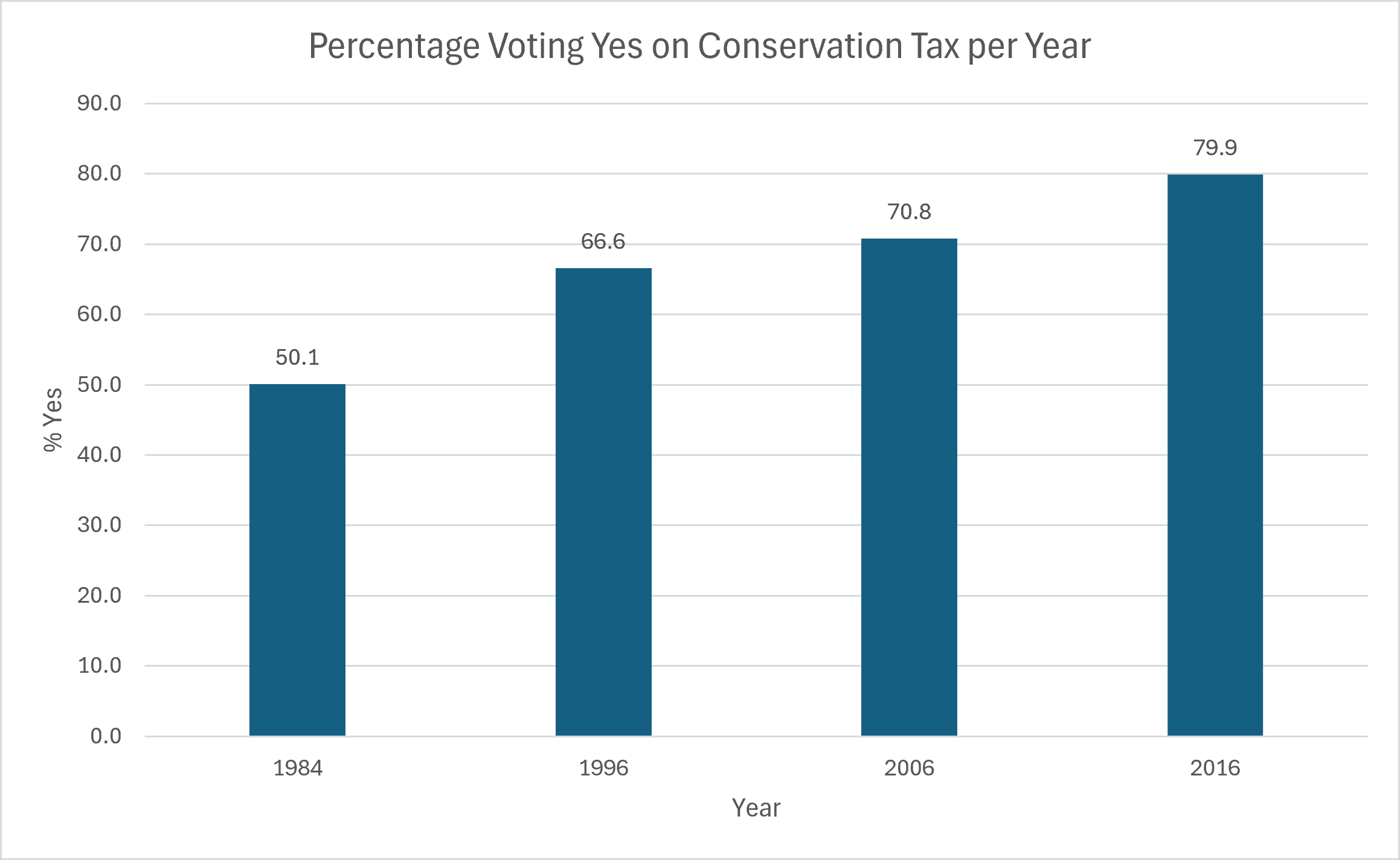
While the first passing of legislation was in 19843, its cycle began in 19964 and has continued since then. Below is a graph that shows the percent voting yes in each year this measure was voted on, including 20065 and 20166:

Of note is that while it barely passed the initial vote in 1984, it has passed by a greater percentage each decade with almost 80% supporting the measure in 2016.
Arguments
In terms of reasons to support this measure, I can think of a few simple ones:
-
This measure is extremely transparent. Unlike some of the other measures this year, the language is very direct and focused. This is not one of those measures that has 5 different things stuffed into it.
-
The tax is small. The median household's financial burden for this tax comes out to around $30.
-
The tax is genuinely useful. Given instances that we now have seen revolving water usage, a fund to protect our water does not seem extreme.
Of reasons to oppose, I can think of two:
-
It is a sales tax. As has been discussed and will be discussed more in future articles, sales taxes are regressive, meaning they disproportionally affect lower-income households more than richer ones. I am not sure on what is technically legal regarding income taxes in Missouri, but if there is any way to separate out income tax into specific itemized funds, that would be a more appropriate way to fund this measure.
-
This probably should not be an amendment. Here in Missouri, we get hung up on amendments for a few reasons, but this seems like a clear case for a law that should be placed in regular statutes. The constitution should ultimately be for laws regarding the structure of the government and fundamental rights of the people in the state. I suppose this could fit under some notion of 'right to clean water', but that would be stretching the argument a bit.
Conclusion
All things considered, I believe this is an example of a good ballot measure. It is written in simple language, it discusses essentially one topic, and the burden of it on Missourians is fairly low while providing what I consider an essential service. Given the history of voting on this measure, I think this measure will pass with a fairly similar rate to how it did in 2016.
Official Recommendation: YES