Missouri 2026 Amendment 5
Send it back to the chef, this amendment is raw
By Curtis Israel
15 min read
Send it back to the chef, this amendment is raw
Of the four measures on the ballot for the August Primary election, Amendment 5 is the one that will have the most real impact on Missourians (Amendment 4 is arguably more important, but in a more ideological sense). Let’s take a look at the text, the arguments, and why I believe you should be voting ‘No’ on this measure. Be warned, this is a very math-heavy amendment, but I will do my best to try to show all the work and make it as clear as possible.
Here is the official summary of this amendment1:
Shall the Missouri Constitution be amended to:
Require legislative phase-out of the individual state income tax based on revenue growth, and authorize the expansion of sales and use taxes;
Curtail constitutional limits on taxing goods and services; and
Require local tax rate cuts without reducing school funding if local sales tax revenue increases?
The proposal has no direct impact on state or local tax revenue. If passed, implementing legislation will have an unknown impact to state and local tax revenue. If implemented, state government entities expect a reduction of $57,000 annually in income tax check-off donations and implementation costs of at least $100,000.
The full text that will appear in the amendment is too long to quote here fully, but here2 is the link where you can read it. In particular, we can look at a block from it that I think is most relevant to how this whole thing really works in practice:
Section 26. 1. In order to prohibit an increase in the tax burden on the citizens of Missouri, state and local sales and use taxes (or any similar transaction-based tax) shall not be expanded to impose taxes on any service or transaction that was not subject to sales, use or similar transaction-based tax on January 1, 2015.
2. (1) Notwithstanding any provision of this constitution to the contrary, including subsection 1 of this section, for the purpose of reducing and eliminating the state individual income tax and reducing local tax rates, state and local sales and use taxes (or any similar transaction-based tax) may be expanded by legislation to impose taxes on transactions involving any goods and services.
The section in bold is the one that is newly added from this amendment, but I added the first non-bolded section because it is directly referenced by this amendment. The original text has this Section 26 subsection 1 which says that we cannot impose sales and use taxes on anything that was not already being taxed in 2015. As George H.W. Bush would say, “No new taxes.”
In a similar fashion to what happened to Bush during his presidency, this new amendment basically says that line was a lie. The very first line of this new text, which states that the restriction on new taxes doesn’t apply, ignore it. We are adding new taxes. We are going to heavily increase sales taxes. In fact, we are going to replace all of our state income tax with sales taxes.
The question now becomes how much of Missouri revenue comes from income taxes. The short answer is most of it. Let’s take a look at it now.
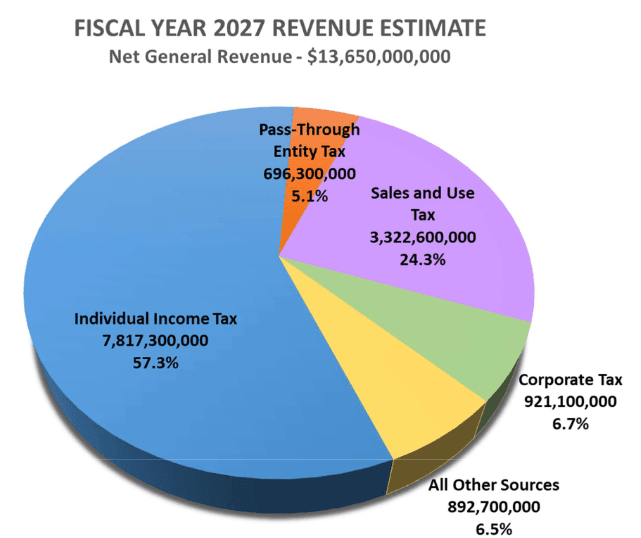
This chart above depicts the general revenue portion of the Missouri budget for the fiscal year 2027. As a reminder, fiscal year 2027 just started on July 1, 2026, so this is an approximation of the next year, but it matches closely with previous years. Additionally, this is not actually the full budget, but the other part of it (which you can see here) is not relevant because it pertains to funding outside of the normal taxes we are talking about.
As can be seen, the majority of general revenue comes from individual income taxes (57%). Sales taxes in contrast make up only 24%. We also know what Missouri’s general sales tax rate is (3%)3, so from this information we can do a calculation that shows how much the sales tax would need to replace the income tax. If sales tax brings in $3,322,600,000 at 3% rate, then each 1% state sales tax brings in $1,107,533,333. Thus, to replace $7,817,300,000, the additional sales tax would have to be raised by 7%. So that means our general state’s sales tax rate is now 10% instead of 3%.
But we are not done with the state tax section. 10% is the general rate, but we are missing another part of the Missouri sales tax which includes the conservation fund, the school fund, and parks/soil fund, which comprise another 1.125%. Thus, our Missouri sales tax is 11.125%. Not terrible, right? Well, we still aren’t done because we have to remember that when we pay sales tax, we are also paying a portion to our local community, so let’s look at that side of things in the next section.
Note: For the rest of this article, we will assume that the tax base will not increase and that only this general tax rate will increase. The reason for this is that because there are no written guarantees about what will be taxed and won’t be, it is impossible to make any model that could be accurate in this situation.
Unfortunately, we will not be able to come up with a single number for this section due to variability across all the different localities, but I can at least provide an example using some of my local. Here you can see at the fast-food place in Fenton, MO, I paid $0.81 tax on a subtotal of $9.79 for a tax rate of 8.27%.
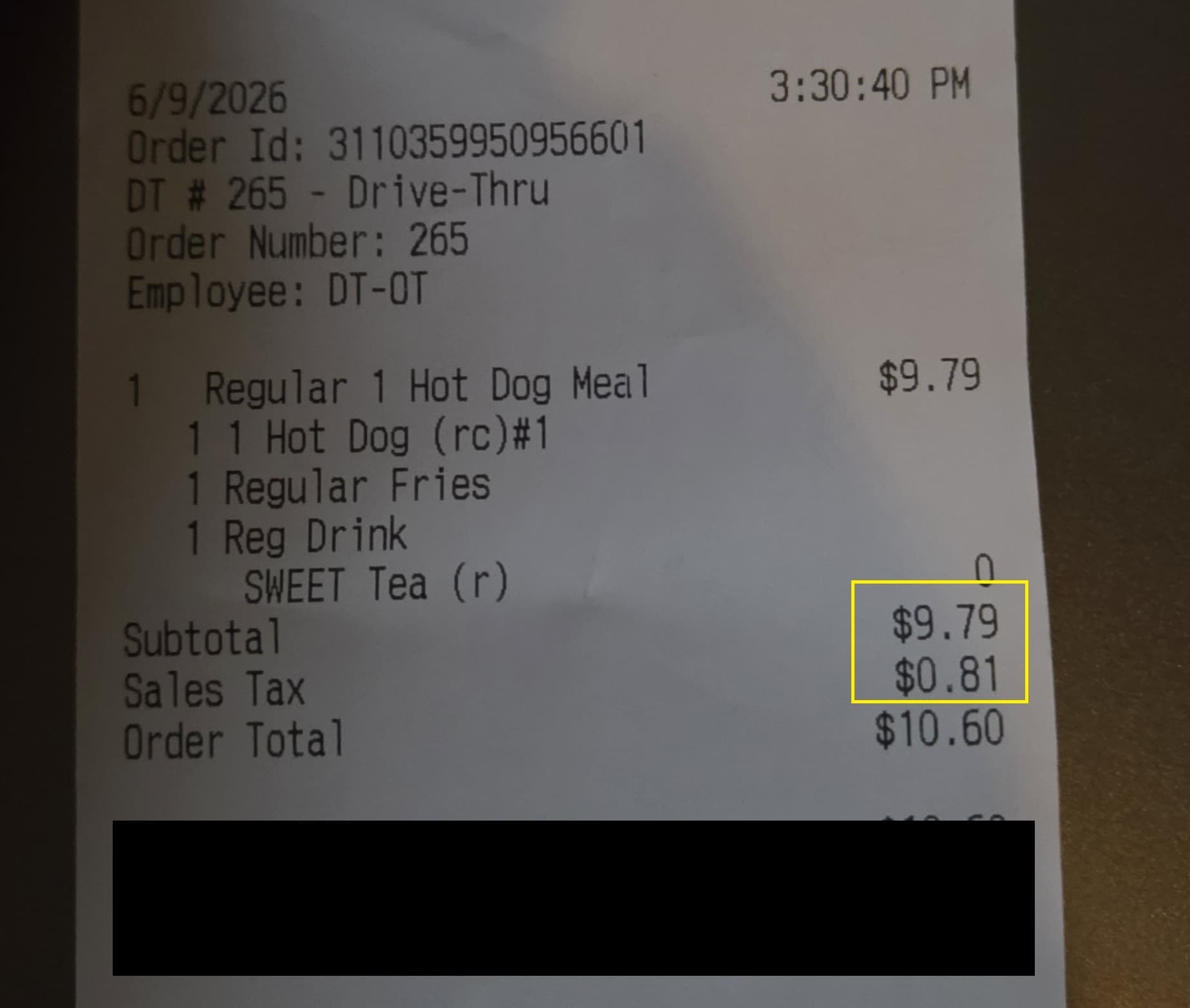
Now for sales taxes, businesses put all the different rates into one that you actually pay, but really this is the sum of the Missouri and local rates. So, for the fast-food joint tax rate, I am paying the MO rate (4.125%) in addition to any local rate (4.145). At a Costco in Manchester I actually paid a reduced MO rate (5.6%) because in store I pay a smaller food rate (1.125%) while fast food is generally at the normal MO rate (4.125%).
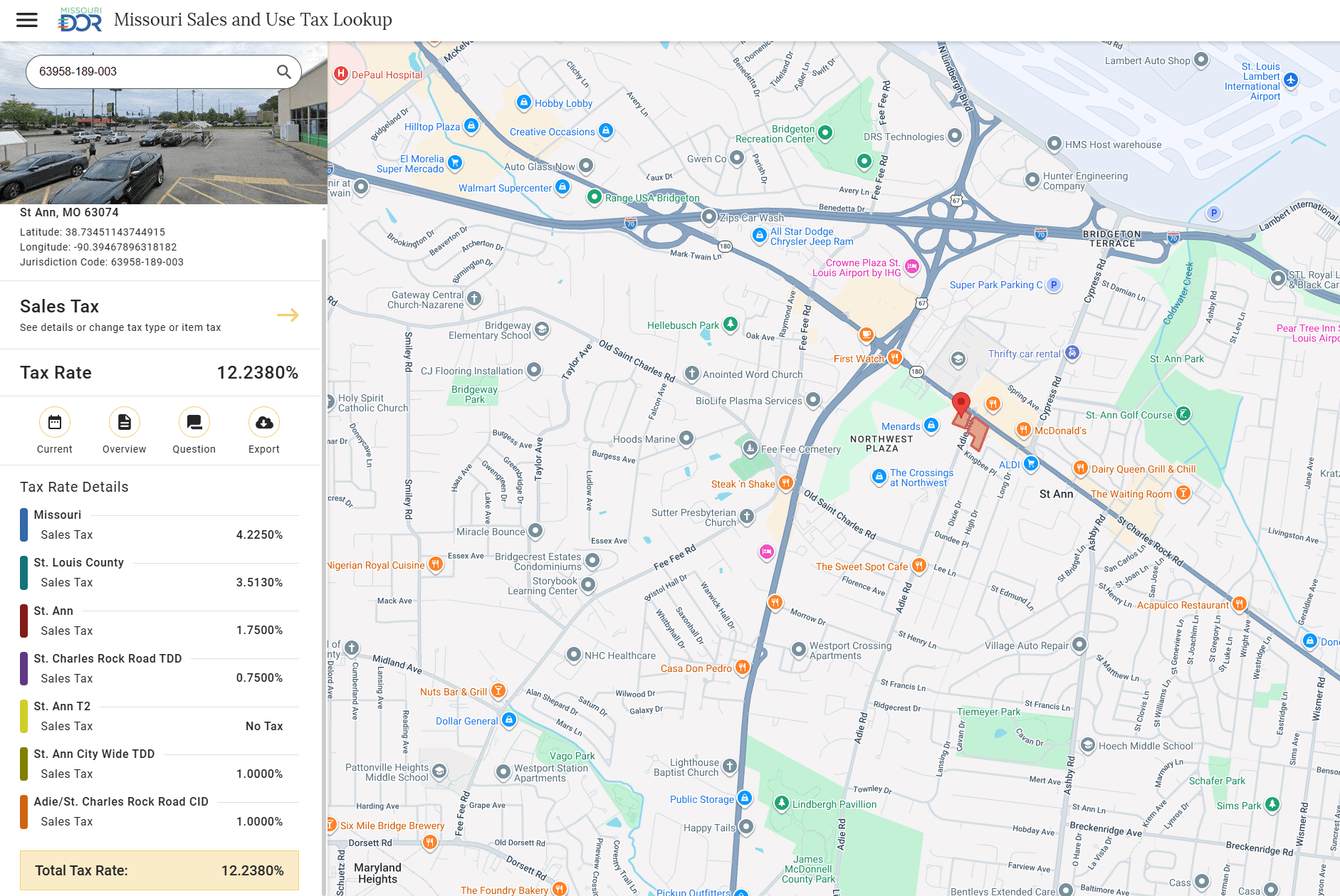
As we can see, sales taxes are actually a lot of work to analyze, but at this point I can give a single data point of what I would expect in income tax was eliminated and replaced with just more sales tax: In Fenton, MO I would go from a typical rate of 8.27% up to 15.27% for an increase in my sales tax rate of 85%. In some areas of MO this could be higher or lower, but this is what I will reference in the rest of the article as a calculated example. However, to provide some context for the range, you can use this table4 that lists the sales tax rate for each jurisdiction. If you sort by the Sales Tax Rate column, you will see that the lowest rate is in St. Clair County (4.725%) which is located in western Missouri, while the highest rate is in St. Ann (12.238%) which is just northwest of St. Louis. Adding the 7% rate from eliminating income tax then gives us a Missouri-wide range of 11.725-19.24. For those who are interested, you can also use this website5 and map out where you actually shop to see what your tax rate is at these locations, and it breaks it down into all the local funds. For example, here is the map for the St. Ann location:
For a state comparison, here is the data6 on all states and their tax rates. Below is chart where I plot Missouri’s max combined rate from St. Ann of 12.238% against the other highest states:
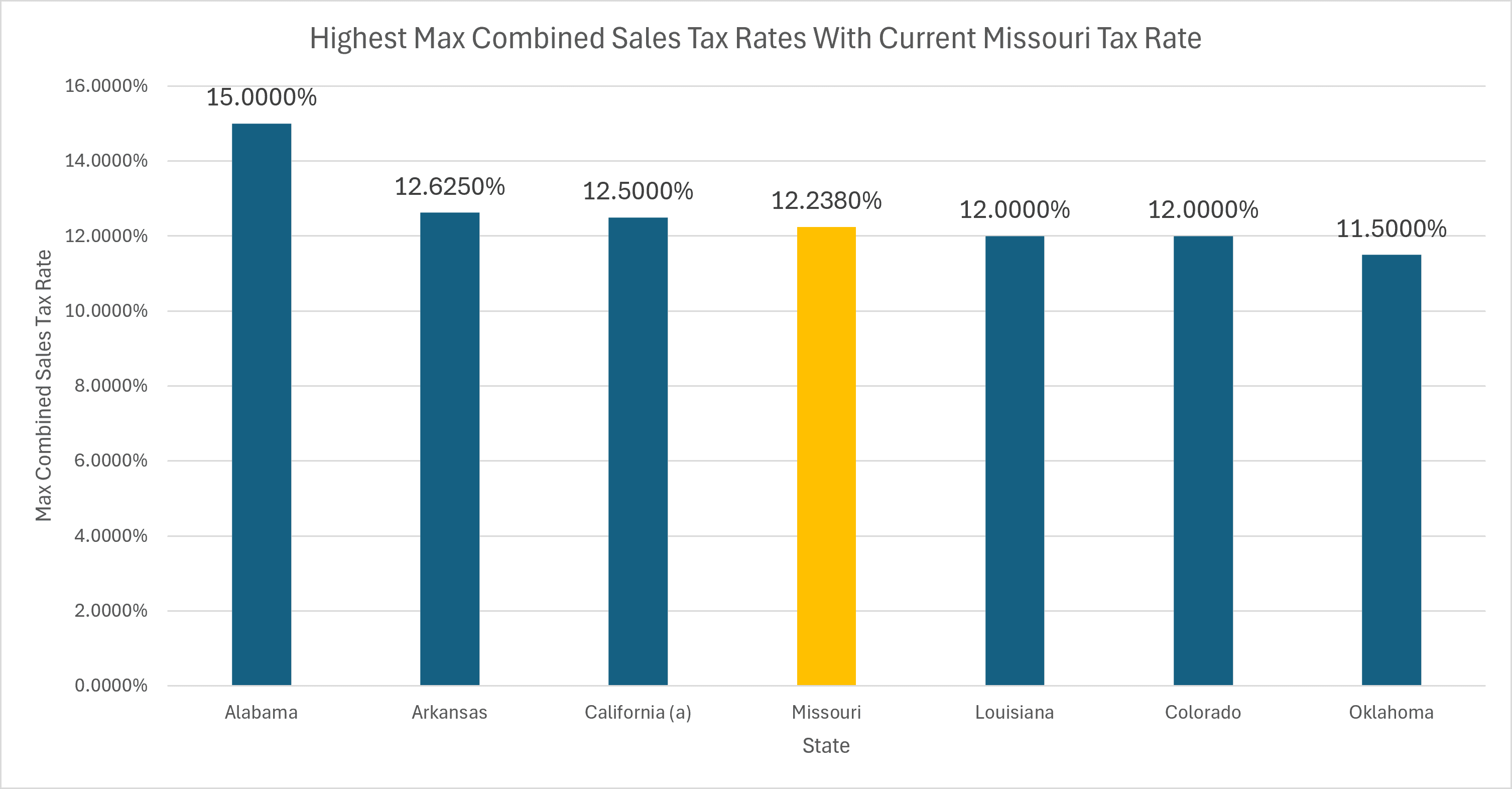
As can be seen, Missouri’s combined rate places it fourth highest, and that is the current rate before any sales tax increases. In the next graph, I instead place Missouri’s new average and maximum combined rate:
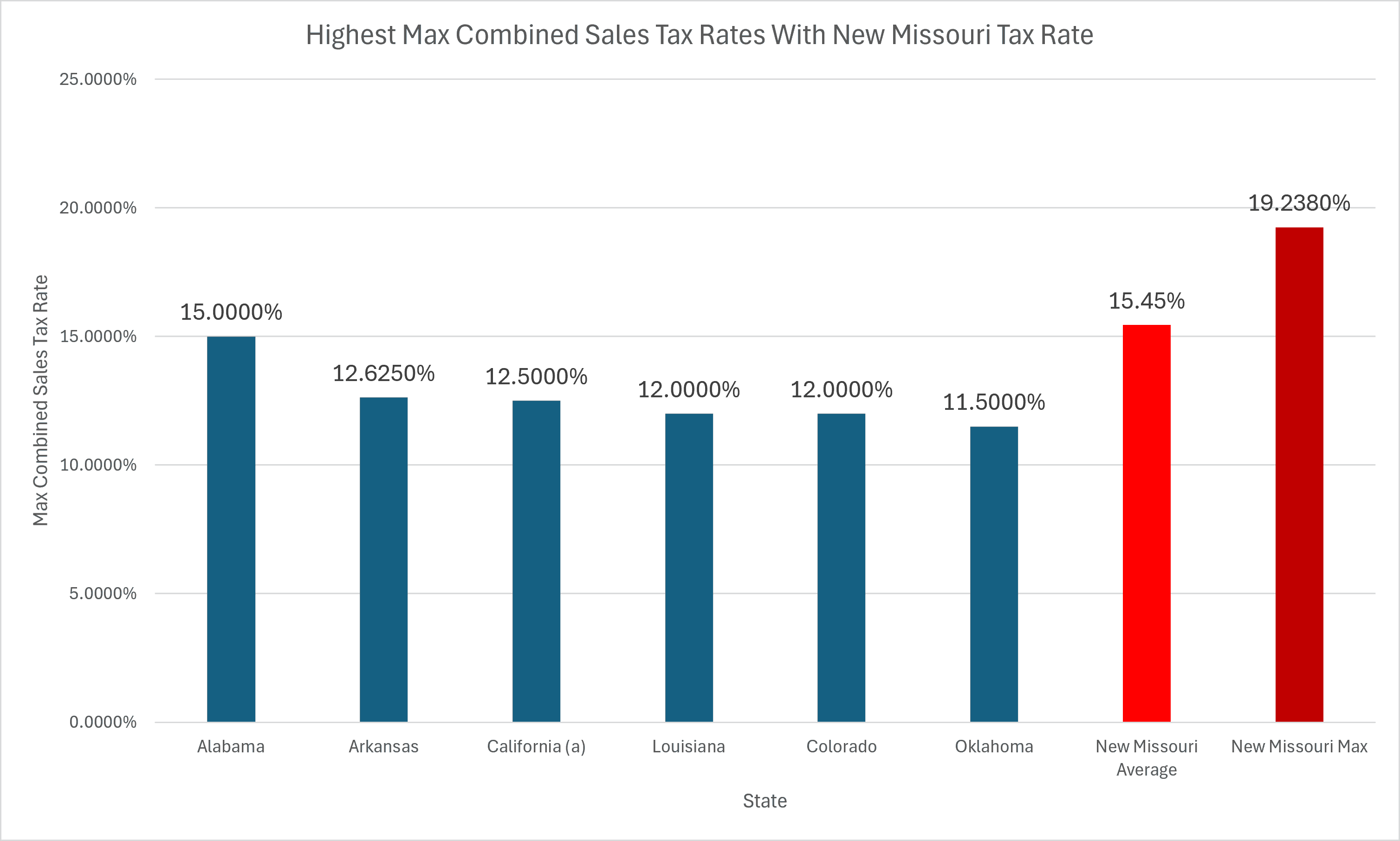
As seen above, Missouri’s new average sales tax rate across the state would be higher than any other state’s max rate. Missouri’s max rate of over 19% would be far higher than the next state, which is Alabama at 15%.
To summarize this section, Missouri is already one of the higher sales tax states. With an increase in the sales tax rate necessary to make up for income tax elimination, Missouri would have by far the highest sales tax in the country, some places in Missouri be 33% higher than anywhere else and approaching that 20% number that many Amendment 5 supporters say is impossible to reach.
The next question to address to figure out what this percentage really means is what do I pay in sales tax each year? As you may guess, this is also a difficult question to answer.
Truly the only way for any individual to calculate this is to collect all their receipts for a year and sum the tax on them up, but that is going to be a large ask for any reasonable person. Instead, an approximate way to do this is just survey people on their overall spending habits and infer what the tax would be from the rates. While this does not produce exact values (everyone’s spending habits do differ), it can describe groups of people accurately. One institution that has done this is the Institute on Taxation and Economic Policy (ITEP).
ITEP collects their data from public sources (Census, IRS, Missouri) and packages it up for us so that we can learn how people are actually taxed. Here is a chart that shows the percentage of sales tax they pay compared to their household income7:
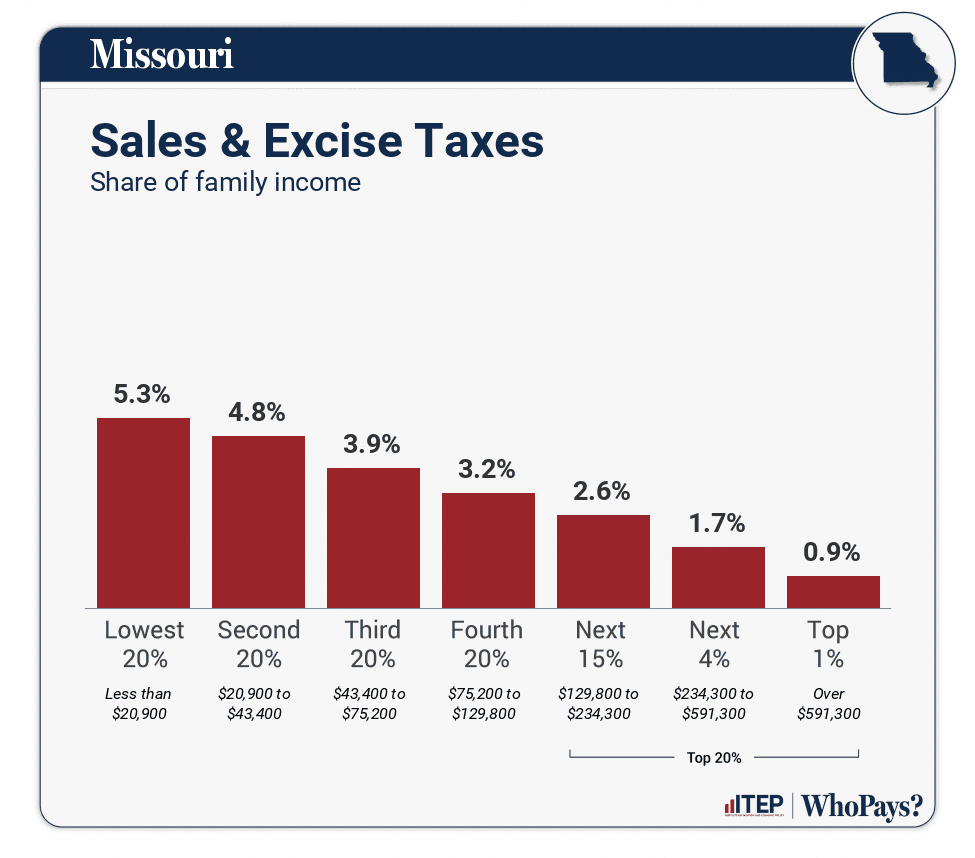
As can be seen, people in the lower percentiles pay significantly more of their income to sales tax. The answer to this is purely spending habits. At very low incomes (less than $20k/yr), people are forced to spend most of the income on goods that are ultimately taxable, from food to clothing to household goods). As income rises the percentage spent on sales tax decreases because more money is spent on things that you do not pay sales taxes on (services, mortgages, etc.) Despite people having the ability to buy more as their income goes up, the actual percentage does not go up because a family making $100k is not going to buy twice as much in taxable goods as a family making $50k.
Using this chart, we can get absolute numbers of how much sales tax costs people in these income brackets. For example, a family in the bottom 20% of income pays about 5.3% of their income in taxes, so we can estimate they pay about $600 dollars in sales tax on an average income of about $12,000.
For readers, simply find which column contains your family income, then multiply your income by the percentage to see an approximation of how much you pay in sales tax per year. If you are a typical consumer, this should be fairly accurate value compared to what you actually pay.
For reference later, my income of $115,000 places me in the 3.2% sales tax column, so multiplying these together I see that someone in my group pays around $3,700 in sales tax per year. Remember that number for later.
Now that we can estimate how much we pay in sales tax, we can much more easily calculate our state income tax. All we have to do is take your gross wages, apply some deductions, and use this table for Missouri tax rates8.
For example, in 2024 (I chose the last year I was not between jobs so I could have a full year salary as an easy example), I had a gross wage of $116482, I subtract $29,200 for the married deduction to get down to $87,282 then we go to the tax table. I subtract $8911 from $87,282, then multiply by 4.8% to get 3761. Finally, I add $248 from the tax table to get a total income tax of $4009. Now let’s compare this value to what was actually on my return:

As you can see my numbers are in the ballpark (only off $26). This is because there is a business income deduction that is on another page, but the point stands. These tables are accurate and I encourage everyone to doublecheck their previous returns to make sure you can get a value that is very close. Otherwise, there might actually be some problems with your return.
As you can see, at my income I pay only a couple hundred more in income tax than in sales tax, so an income tax elimination seems like it would be a good idea, but that depends on how much the sales tax increase would be. Additionally, you have to remember that at $115,000, I am actually at around the 65-70 percentile in household income9, so as you go down in income, you will be paying relatively less in income tax and relatively more in sales tax, so an income tax elimination benefits less and less. At very low incomes, income tax elimination does not benefit you at all because you don’t have any taxable income.
There are a few different groups of people that would want this:
Single filer with incomes over $100,000 and married filing jointly (MFJ) with incomes over $200,000. These are groups of people who stand to save at least $5,000 a year from this change provided that they do not overspend on various taxable goods and services.
People who think they pay a lot more in state income tax than they actually do. Please calculate how much you pay; it is not as much as you think. Again, we are looking only at state income tax, not income tax in general.
People who consider themselves more frugal than others. Again, try to add up your receipts for a year and check how much sales tax you paid. It is probably going to be higher than you think.
Let’s address some things I have heard regarding Amendment 5:
Technically this is possible, but impossible to predict. Without giving specifics (which the legislators did not want to do, although they did include a section about how school funding would not be affected), there is no mathematical model that can given. There is a hypothetical situation where the tax base is increased on only things that high-income families use, but without it being written down, there are no promises. The only thing that I can demonstrate is what the tax rate would be if it was increased to make up for the income tax. Whether the tax rate is increased or the tax base is increased, the total amount of sales taxes as a whole must increase, and this increase is worse for lower-income families.
Again, impossible to predict. While there are states that have done well with economic growth and no income tax, there are also states that have done well in growth with higher income taxes. There is no causal relationship that can be seen. Additionally, Missouri would be one of the first states to go from having an income tax to not having one, so the comparison is hard to make with states that have never had an income tax in the first place.
True, instead it would mean the government would step between you and every seller or service provider instead.
This is the only amendment here where your own due diligence is needed. For many people, calculating how much sales tax they paid in a year will be almost impossible, which makes understanding this very difficult, but other organizations have already done this and have a good idea of the numbers. If you are less than 50% household income in Missouri (~$70,000) you almost assuredly pay more in sales tax than you do in state income tax. But even if you do have a high income, and this change would be beneficial, please think about people who are not in your situation.
Sales taxes are regressive, and they hurt lower-income families more. For many people who are disabled, on social security, have low paying jobs, etc., this will be absolutely devastating. People with the least to spare will be forced to pay more just to survive. Despite all the talk, most protections that proponents have discussed are only verbal, not written into the constitution. Be wary of anyone who says we will figure out the correct way of handling this now. Do not fundamentally change the way Missouri collects revenue with such an awfully written bill with almost no protections about what will be taxed.
Official Recommendation: NO
Sign in with your Google account to comment and interact with other readers.