Missouri 2026 Ballot Measures Review
This article outlines the currently certified ballot measures and potential measures for Missouri in 2026.
- Introduction
- Amendment 1: Soil and Water Conservation and Historic Site Tax
- Amendment 2: County Assessor Election
- Amendment 3: Reproductive Healthcare Repeal
- Amendment 4: Unanimous Congressional District Support
- Amendment 5: Income Tax and Sales Tax Swap
- Election of County Sheriffs Amendment
- Show Me Prosperity Fund Amendment
- Congressional Map Referendum
- Initiative Protection Amendment
- Conclusion
Introduction
This year in Missouri we have a set of amendments that have already been certified by the Secretary of State Denny Hoskins and will appear on the ballot this year.1 On May 22, 2026, Governor Mike Kehoe determined that amendments 1, 2, 4, and 5 would appear in the primary election that will take place on August 4, 2026, while amendment 3 will appear on the general election ballot on November 3, 2026.2 In addition to these amendments, there are two that have also passed as SJR 87 and SJR 95 that are not currently shown on the ballot measures website as of June 12, 2026 and so are not yet numbered, but will probably be amendment 6 and 7, respectively.3,4 Any future measures that are certified will have to be placed in November, which include the citizen-led veto referendum of the redistricting map and the initiative to prevent the legislature from modifying the petition and initiative process.5,6 This all means that this year we may have up to 9 ballot measures, so understanding what all of these entail is important so that there are no surprises when Missourians go to vote.
The ballot measures this year range from fairly mundane (keeping a tax that funds conservation efforts ) and filling in what appears to be a legislative oversight (requiring Jackon county to have an elected assessor like every other county) to more severe changes such as reversing amendments that were just approved in 2024 (amendment 3), modifying the ability of citizens to actually engage in these measures (amendment 4, initiative to prevent legislative tampering) and fundamentally altering how Missouri actually raises tax revenue (amendment 5). Although this could be said for every election year, the stakes for some of these changes feels higher than normal, particularly amendment 4 and the petition. The consequences of these amendments could mean that citizen-led petitions and initiatives would be almost impossible to pass.
Now that we have covered the summary, let’s go into a bit more detail on each measure. For more information, I highly recommend using Ballotpedia since it collects a large amount of supplementary information regarding each measure.7
Amendment 1: Soil and Water Conservation and Historic Site Tax
Here is the official text:
Shall Missouri continue for 10 years the one-tenth of one percent sales/use tax that is used for soil and water conservation and for state parks and historic sites, and resubmit this tax to the voters for approval in 10 years?
The measure allows continued collection of the existing sales and use tax, which generates revenue of approximately $140 million annually.
In summary, we already have a sales/use tax for this, and a yes vote will continue this tax for the next 10 years. At that point, this measure will come up again. The tax is currently at .1%, which generates about $140 million annually. Of all the ballot measures, this is probably the easiest to understand, but it is still consequential. Without additional legislation, a “NO” vote on this measure would severely hinder the ability of the state government to protect these valuable resources. The last time this measure was on the ballot in 2016, this measure passed with almost 80% of the vote.
While I am generally opposed to sales taxes (income tax are much more effective and fair to the majority of the population, as we will discuss later), this is a fairly low tax that has been going on for quite some time and without replacement legislature, there is no other revenue source for this important work. Protecting our soil, water, and our environment in general is important and we need to do what we can to help, especially when the cost here is relatively low.
Recommendation: YES
Amendment 2: County Assessor Election
Here is the official text:
Shall the Missouri Constitution be amended to:
require all charter counties, including Jackson County, to provide for the election of a county assessor; and
require assessors in all charter counties to comply with any training requirements established by general law?
State and local governmental entities estimate no costs or savings.
This one is kind of a strange amendment. The Missouri Constitution contains language that exempts counties of certain population from being required to have an elected assessor. Of all the counties in the state, Jackson County is the only one that meets this threshold.
Last year, voters in Jackson County already passed a question with 90% approval to have an elected assessor.8 This statewide measure is just another check on this idea and makes sure that all counties have the same requirement written into the constitution. Specifically, this measure deletes language from the constitution allowing for a specific range of county populations to be exempt.
Since local voters already approved a similar measure, I see no reason why this language should exist anymore, so a “YES” vote deletes the exception.
Recommendation: YES
Amendment 3: Reproductive Healthcare Repeal
Here is the official text:
Shall the Missouri Constitution be amended to:
Repeal the 2024 voter-approved Amendment providing reproductive healthcare rights, including abortion through fetal viability;
Allow abortions for rape and incest (under twelve-weeks’ gestation), emergencies, and fetal anomalies;
Allow legislation regulating abortion;
Ensure parental consent for minors’ abortions;
Prohibit gender transition procedures for minors?
State governmental entities estimate no costs or savings. Greene County estimates it may experience an unknown increase in tax revenue. Other local governmental entities estimate no costs or savings.
In 2024, Missouri voters approved Amendment 3 with a 3% advantage, enshrining into the constitution a fundamental right to reproductive freedom.9 This amendment specifically removed Missouri’s blanket ban on abortion while allowing restrictions on abortions past the point of fetal viability unless the women’s life or health was in danger. Despite this, a new amendment to repeal this amendment is on the ballot this year in November.
In addition to banning abortion, this new amendment sneaks in a gender transition ban which goes against Missouri’s single subject policy for bills.
It is important to note that since this is a repeal of what passed previously, you will need to vote the opposite of how you did in 2024 in terms of “YES” and “NO”. If you voted “YES” in 2024, you now must vote “NO” here to keep abortion legal in Missouri.
Recommendation: NO
Amendment 4: Unanimous Congressional District Support
Here is the official text:
Shall the Missouri Constitution be amended to:
Modify current requirements that a statewide majority of voters may approve initiative petitions to amend the constitution;
Require a majority of voters in each congressional district to approve initiative petitions to amend the constitution; and
Make available to each voter the full text of initiative petitions with their ballot?
The Department of Corrections estimates increased annual costs of up to $21,817. The Office of State Public Defender estimates an unknown fiscal impact. Other state governmental entities estimate no costs or savings. Local governmental entities estimate no costs or savings.
I would argue that of the current certified amendments, this may be the most important one due to the way it would restrict all future citizen attempts to introduce legislation.
Currently, any of these amendments are approved if they get a simple majority (50% + 1) across the state. This amendment would eliminate that requirement only for citizen-initiated amendments and instead require a simple majority in all 8 of Missouri’s congressional districts.
As a way of comparison, let’s talk about the Electoral College, ignoring whether we approve or disapprove of the concept. Instead of a pure popular vote, we have electors from each state, with the reasoning being that this forces candidates to have broad appeal across the whole country instead of just a few select areas. You can think of this amendment as being the reverse extreme of this where you place all the power within a single district.
As an example, imagine a scenario where an amendment is placed on the ballot, and every single voter in districts 2 through 8 votes yes, but fails district 1 by one vote. Using the numbers from the 2024 general election for each district10, that means an amendment could fail while getting over 94% of the vote across the state:
| District | Yes | No | Total | Yes % |
|---|---|---|---|---|
| 1 | 153632 | 153633 | 307265 | 49.9998 |
| 2 | 428392 | 0 | 428392 | 100.0 |
| 3 | 392463 | 0 | 392463 | 100.0 |
| 4 | 365696 | 0 | 365696 | 100.0 |
| 5 | 331929 | 0 | 331929 | 100.0 |
| 6 | 375186 | 0 | 375186 | 100.0 |
| 7 | 367868 | 0 | 367868 | 100.0 |
| 8 | 356064 | 0 | 356064 | 100.0 |
| Total | 2771230 | 153633 | 2924863 | 94.7 |
In this instance, 153,633 votes now defeat 2,771,230 meaning 95% of the vote is not enough to get approval.
The extreme numbers I used are a contrived, but theoretically possible outcome. All it now takes is a coordinated campaign within one district to invalidate the vote of the other 7 districts. It is plain to see how this is a major problem and ultimately strips away the ability of voters to be accurately represented.
Recommendation: NO
Amendment 5: Income Tax and Sales Tax Swap
Here is the official text:
Shall the Missouri Constitution be amended to:
Require legislative phase-out of the individual state income tax based on revenue growth, and authorize the expansion of sales and use taxes;
Curtail constitutional limits on taxing goods and services; and
Require local tax rate cuts without reducing school funding if local sales tax revenue increases?
The proposal has no direct impact on state or local tax revenue. If passed, implementing legislation will have an unknown impact to state and local tax revenue. If implemented, state government entities expect a reduction of $57,000 annually in income tax check-off donations and implementation costs of at least $100,000.
A very important thing to note about this summary is it was recently rewritten due to a lawsuit.11 The original text did was determined by the Missouri courts to not accurately reflect the actual changes in the constitution. The above text is now the final summary because the appeal to the Missouri Supreme Court was denied12.
Here is the how the original text was written:
Shall the Missouri Constitution be amended to:
Phase-out the individual income tax based on revenue growth;
Reduce personal property and other local taxes when local revenues increase;
Modify the sales and use tax to eliminate income tax and reduce local taxes; and
Protect local funding for public schools and other purposes?
The proposal has no direct impact on state or local tax revenue. If passed, implementing legislation will have an unknown impact to state and local tax revenue. If implemented, state government entities expect a reduction of $57,000 annually in income tax check-off donations and implementation costs of at least $100,000.
As you can see, the text has now been changed to more strongly show how the income tax reduction is being paired with an expansion of sales tax. Be wary of any politicians who are suggesting that this amendment is just ‘lowering taxes’ because that is not the case.
Despite my liberal lean, exemplified by my recommendation for Amendment 3, I am trying to talk about these through the lens of all MO voters. While some may disagree with 3 (and if you are happy with full GOP control of MO, 4 as well), Amendment 5 is not a partisan amendment. You should absolutely look at how your representative (HJR 173/174, pg. 1876) and senator (pg. 1011) voted on this because this bill is a negative for roughly 90% of all Missourians.13<sup>,</sup>14 If you need to look up who represents your districts, use this tool15.
The answer to why this is a bad amendment for the majority is a long one, but the simplest answer comes down to understanding how much you pay in income tax and how much you pay in sales tax. What follows is essentially a math problem, so prepare yourself. Here is a table that breaks down three voters (all assumed to be filing as Married Filing Jointly): the median voter (50%), a high income voter (~80%), and a top 1%-er.
| Voter | Income (2024) | Standard Deduction (MFJ, 2024) | Missouri Taxable | Income Tax | Tax % of Income | Sales Tax % (ITEP) | Sales Tax | Sales Tax % Income |
|---|---|---|---|---|---|---|---|---|
| Median Household (50%) | 70,702 | 29,200 | 41,502 | 1812.368 | 2.6% | 3.9 | 2757.378 | 3.9% |
| High (80%) | 129,800 | 29,200 | 100,600 | 4649.072 | 3.6% | 2.6 | 3374.8 | 2.6% |
| Top 1% | 591,300 | 29,200 | 562,100 | 26801.072 | 4.5% | 0.9 | 5321.7 | 0.9% |
This table was created by using information from ITEP to get income and sales tax % values and using Missouri’s 2024 tax rates and standard deduction to calculate actual income tax.16,17,18 To further summarize the comparison, let’s just look at our final income tax and sales tax values:
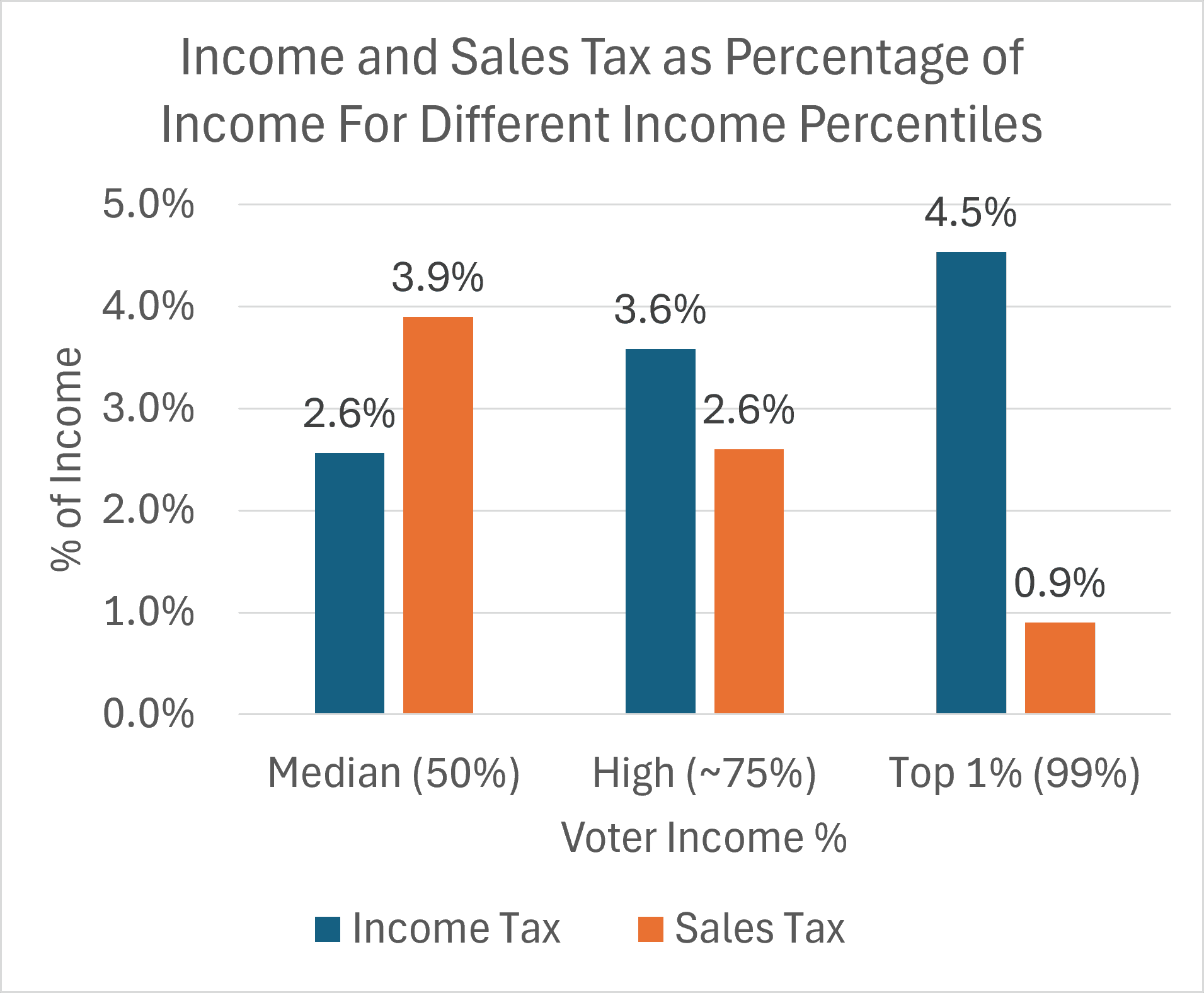
As can be seen in this chart, the median voter pays about 50% more in sales tax, while the top 1% pays about 5 times more in income tax proportional to their income. Around 75% is close to a break-even point, but I also did not include that for Missouri, you can deduct your federal income tax as well, so these values would be a bit lower. Additionally, you must remember that for the bottom 20%, they are not paying any income tax due to the standard deduction, and seniors do not pay income tax on social security. An income tax deduction has absolutely zero effect on these groups, which collectively make up a large amount of the total voter share.
In summary, most Missourians (~70%) already pay more in sales tax than they do in income tax. The people who want this passed are counting on people underestimating how much they pay in sales tax when you add up every single purchase throughout the year. This is a bill designed to give the absolute richest voters in Missouri a large tax break and instead forcing the rest of us to make up the difference. Supporters of this bill will probably drive the messaging for this bill as “lowering your taxes”, but this is plainly a tax increase for most voters in the state.
Recommendation: NO
Election of County Sheriffs Amendment
Here is the official text:
Shall the Missouri Constitution be amended to support law enforcement by preserving the right of citizens to elect a county sheriff, prohibiting the removal of a county sheriff except by a writ of quo warranto, and recognizing the office of sheriff as part of the administration of justice?.
This is another strange amendment, mainly due to the wording of the summary. “… to support law enforcement by preserving the right of citizens …” is unnecessary and pulls in a strong pro-right, pro-police ideology. Does this addition affect my personal feelings on the bill? Perhaps a little, but not enough to make this an instant no vote.
According to Ballotpedia, there doesn’t appear to be any significant support or opposition to this bill.19 As a St. Louis native where sheriffs are elected, I can’t find a significant reason to be against this bill, although the actual text is weird because it has one of those weird population carveouts, but regardless this seems to be a fairly inconsequential amendment I will be voting yes on until I read a strong argument against this amendment.
Recommendation: Undecided
Show Me Prosperity Fund Amendment
Here is the official text:
Shall the Missouri Constitution be amended to establish a permanent public endowment fund to support state government instead of taxing Missouri residents, prohibit the General Assembly from appropriating or diverting the fund, and eliminate state-imposed taxes once the fund generates sufficient revenue to replace them?.
This is another amendment that is based on the idea of lowering taxes. Essentially, an investment account20 would be created that is controlled by Missouri that invests money in the stock market. These types of accounts are used in various countries and states, but they are typically used when the region has some sort of large resource that gives them a surplus of money. Missouri unfortunately does not have this and instead taxpayer dollars would be diverted to this fund. The idea is that eventually the account will earn so much money that we can use its growth to fund the state instead of relying on taxes.
This is quite a lofty goal and no state has actually been able to do a full replacement with this type of wealth fund. Given Missouri already has issues with its current budget, creating this type of fund at this moment does not seem wise when any eventual payout (if it were to ever happen at all) is many years away.
The idea of trying to intelligently invest in order to eventually save Missourians on their taxes is a good idea in theory, but the practice of this would be both unpredictable and difficult to manage in the short-term.
Recommendation: NO
Congressional Map Referendum
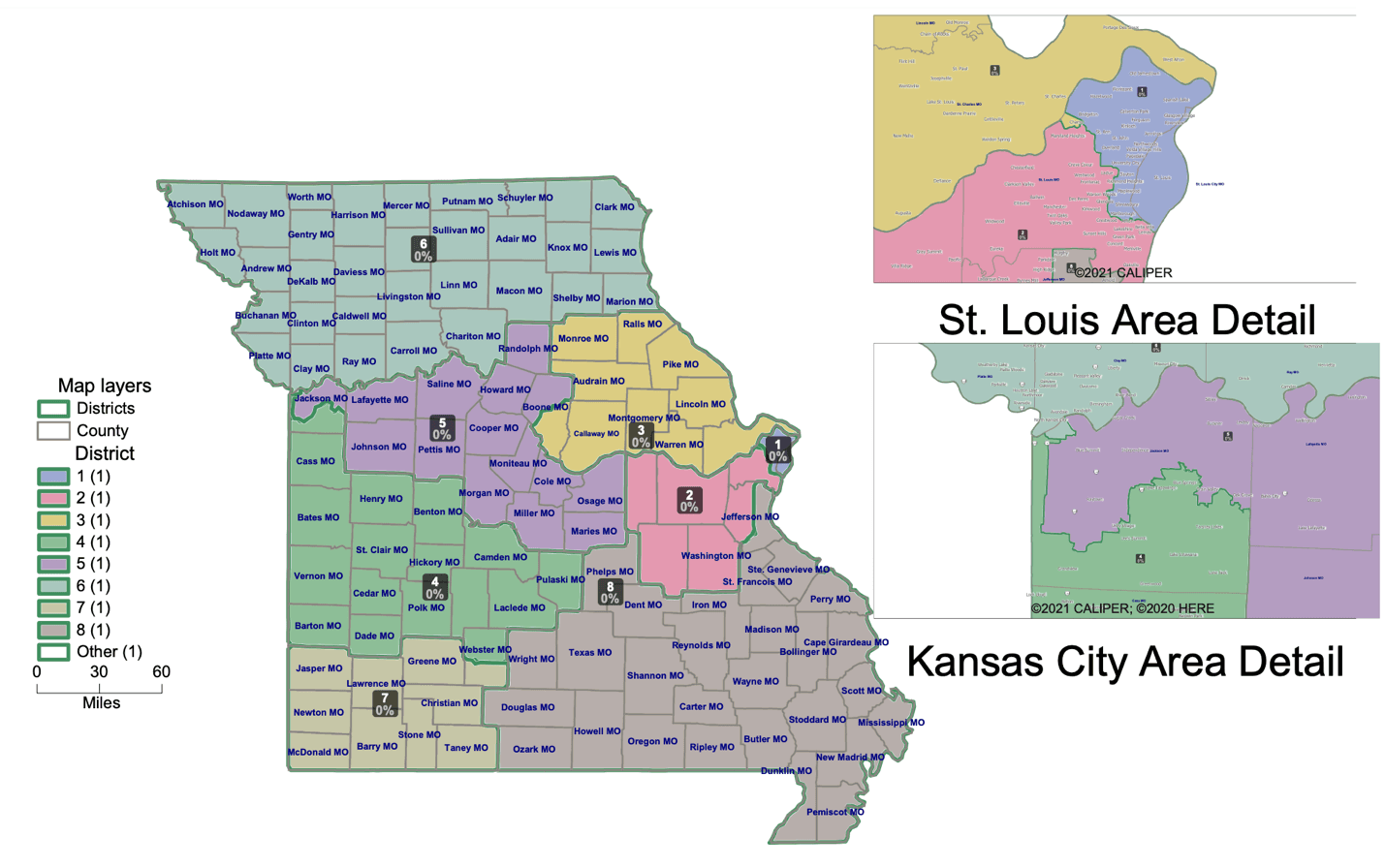
Unlike the other amendments here, this is not its own piece of legislation, but a repeal of HB 1. HB 1 is Missouri’s mid-decade redistricting that other states are also attempting to do. Let’s look at this new map from HB 1 passed in 2025:
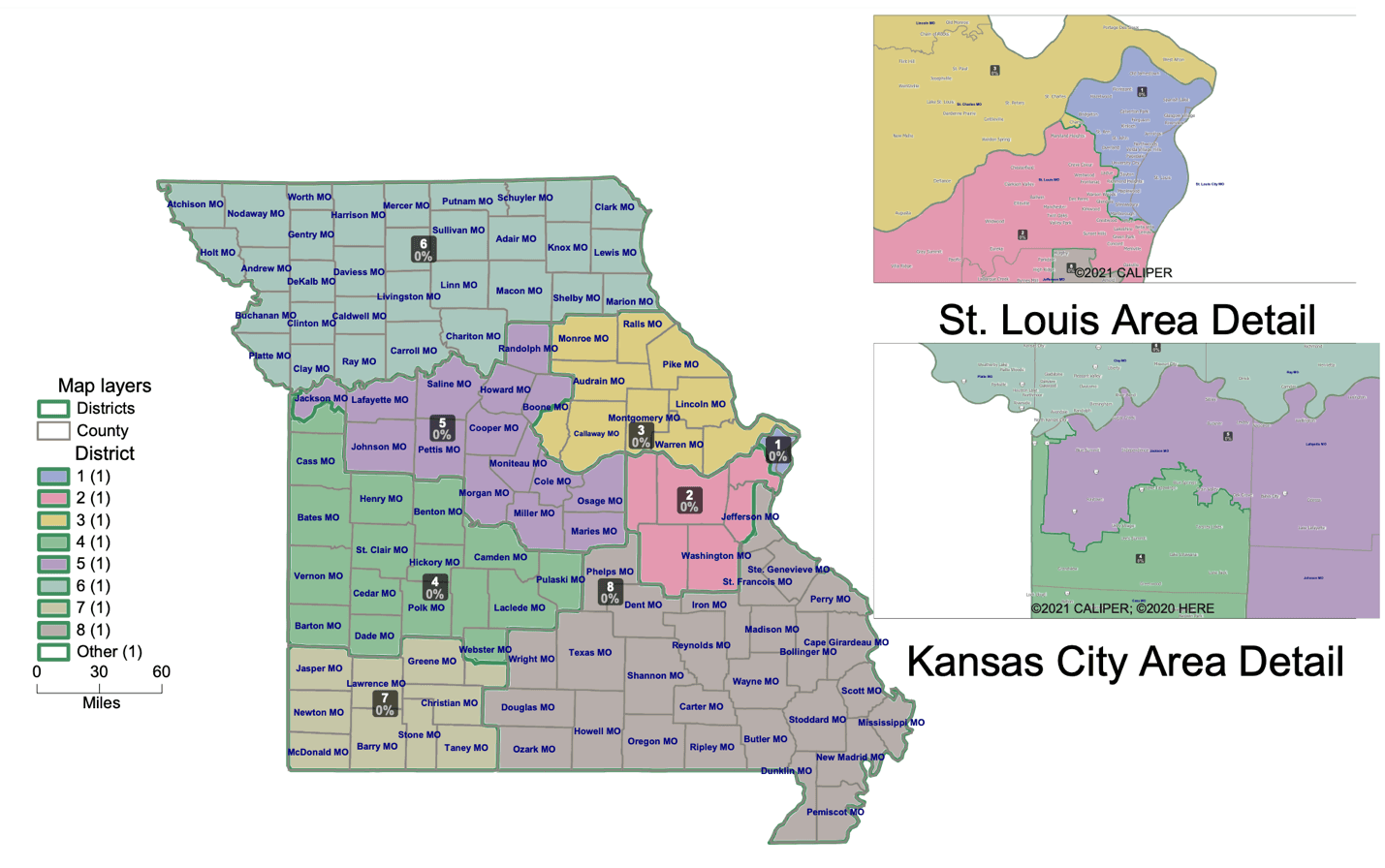
The main difference here is the Kansas City region. The current map provides for 2 Democrat-controlled districts in Kansas City and St. Louis while the other 6 are Republican-controlled. This new map splits Kansas City into pieces that now spread across Missouri, allowing Republicans to control an additional district, giving a 7-1 lead in Missouri.
There is much debate around this bill and its validity but consider how well the old map fairly represents Missouri. In the general election in 2024, Harris received over 40% of the vote, but only two districts are represented by members of the Democrat party, which would be 25%. That means under the old map, Democrats are underrepresented by 15% considering the proportions. Even if Democrats gained another district to go 3/8, this would only be 37.5% which would mean they would still be underrepresented. This new map goes the opposite direction, giving Democrats only 12.5% of the districts available, meaning their underrepresentation is greatly increased by this new map.
Like Amendment 4, this is another attempt to limit the power of the people by significantly hindering the ability to have representatives that match their own values. If this map was really “Missouri First” as it has been billed, the map would be redrawn to be more proportional, not less.
Recommendation: NO
Initiative Protection Amendment
Here is the official text:21
Shall the Missouri Constitution be amended to:
expand the initiative and referendum petition process by making it a fundamental right;
allow courts to revise ballot summaries through lawsuits;
prohibit the legislature from weakening initiative or referendum powers;
prohibit the legislature from changing or repealing laws enacted through the initiative process, or passing laws similar to those rejected by referendum, without approval from at least 80% of both chambers; and
preserve existing majority vote and signature requirements for initiative and referendum petitions?
State and local governmental entities estimate no costs or savings
Respect Mo Voters is the campaign that is leading the charge on this amendment, and the main goal is to protect the rights we currently have as Missourians. Without this amendment, the legislature would continue to have the ability to disrupt these citizen-led initiatives and do what they previously did in 2024 when they challenged Proposition A and successfully removed not only the sick leave mandate, but also the future increases on minimum wage tied to inflation.22
This is an important amendment to fight against changes like Amendment 4 which would make it nearly impossible for citizen-led petitions to pass. In addition to protecting our rights to perform these petitions, this amendment also helps in requiring that ballot summaries are fair and clear, preventing the legislature from using a deliberate deception in their writing.
Recommendation: YES
Conclusion
This is a consequential year for Missouri and its future path. In particular, Amendments 3, 4, 5, and the citizen-led measures (veto referendum on the congressional map and the amendment to protect the initiative process) will greatly affect the rights of people in this state, how the state budget is handled, and the ability of citizens to do bring legislation to the ballot.
Please do your research and try to think about how these measures would affect you, but also others in your community and across the state. Pay attention to how your representatives and senators voted on this bill as you may be assuming they are representing you, but that is not always the case.
Finally, here are my recommendations in a single list, separated into the primary ballot and the general ballot:
August 4, 2026 Ballot:
-
Amendment 1: YES
-
Amendment 2: YES
-
Amendment 4: NO
-
Amendment 5: NO
November 3, 2026 Ballot:
-
Amendment 3: NO
-
Sheriff Amendment: UNDECIDED
-
Show-Me Prosperity Amendment: NO
-
Congressional Map Veto Referendum: NO
-
Initiative Protection Amendment: YES
References
-
https://governor.mo.gov/press-releases/archive/governor-kehoe-places-four-constitutional-amendments-august-primary-election ↩
-
https://www.sos.mo.gov/petitions/2026refcirculation#2026R004 ↩
-
https://www.sos.mo.gov/cmsimages/Elections/Petitions/2026-060.pdf ↩
-
https://jcebmo.org/wp-content/uploads/154_PALL_Election_Summary.pdf ↩
-
https://www.sos.mo.gov/CMSImages/ElectionResultsStatistics/2024GeneralElection.pdf ↩
-
https://www.courts.mo.gov/fv/c/SC101687TransferDeniedOrder.PDF?courtCode=SC&di=219938 ↩
-
https://documents.house.mo.gov/BillTracking/PDFViewer/web/viewer.html?file=https://documents.house.mo.gov/billtracking/bills261/jrnpdf/jrn055.pdf#page=8 ↩
-
https://www.senate.mo.gov/26info/Journals/RDay500415934-1017.pdf ↩
-
https://ballotpedia.org/Missouri_Require_Election_of_County_Sheriffs_Amendment_(2026) ↩
-
Long-term investment fund proposed to eliminate state taxes | Government | missouribusinessalert.com ↩
-
Navigating the repeal: Employer FAQ on paid sick leave changes | Missouri Chamber ↩